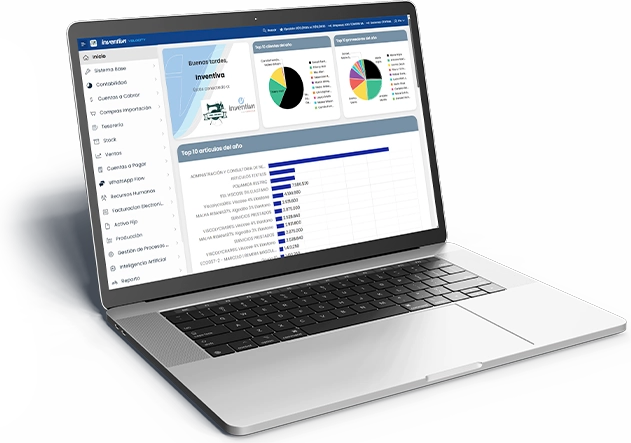

Did you know that Business Intelligence can be the key to optimizing your operations and scaling your business?
Business competitiveness is shaped by the ability to make fast and accurate decisions based on precise and solid data. This is exactly the role played by business intelligence.
According to Oracle:
“Business intelligence keeps your organization informed, and its success largely depends on knowing the market and understanding the who, what, where, when, why, and how.”
Indeed, we are talking about a capable, powerful, and efficient technological tool.
Business intelligence, business analytics, or enterprise intelligence: what is it?
Business Intelligence is a set of tools, processes, and technologies that allow companies to convert collected data into useful information for strategic decision-making.
In essence, business intelligence helps organizations analyze large volumes of data and extract insights that facilitate:
- identifying opportunities,
- improving processes,
- optimizing resources and, ultimately,
- increasing profitability.
Unlike traditional reports, which offer a limited view of past performance, business intelligence offers a more dynamic approach.
And what does that mean?
It means that, in addition to seeing what has already happened, it is possible to forecast “what could happen” in the market, in user behavior, and in other scenarios, in order to anticipate changes.
To make proactive and relevant decisions.
How Does Business Intelligence Work in a Modern ERP?
As a starting point, let’s define what an ERP is.
An ERP (Enterprise Resource Planning) is a business management system that centralizes operations in one place.
By incorporating Business Intelligence, these operations are not only managed, but continuously optimized.
The business intelligence functionality within an ERP allows data collected through different system modules to be analyzed in real time.
Data, and the ability to extract crucial information from it, is the most valuable resource for organizational growth.
Oracle.
In this sense, the collection, integration, analysis, and presentation of data from sales, finance, logistics, human resources, stock, etc. happens automatically.
So you and your team can enter the system and consult all this information in real time without having to manually manipulate large volumes of data.
This process is possible thanks to different tools.
Business Intelligence Tools
For business intelligence to work optimally in an ERP system, specific tools are required to manage, discover, and report data efficiently, including:
1. Data Management Tools
In an ERP system, data management tools ensure that the information flowing between different modules is coherent and accurate.
Thus, the work of these tools is to collect, cleanse, store, organize, and integrate data from different sources, which is fundamental to obtaining reliable insights.
2. Data Discovery Tools
These tools allow data to be explored interactively. With them, your team can identify patterns, trends, and hidden relationships in the data that could go unnoticed with traditional reports.
This is known as data mining and combines various technologies such as artificial intelligence, statistics, and machine learning.
And yes, it is a complex process that happens inside your system to make it easier for you to understand past performance, forecast future scenarios, and design new strategies.
3. Reporting Tools
Reporting tools are responsible for presenting information visually and understandably, which is one of the main benefits of business intelligence.
And how is this information presented?
Through dashboards, charts, and detailed reports that allow you to clearly, quickly, and understandably visualize the status of different aspects of the company.
But let’s leave the technical aspects aside and go to practice…
Business Areas Where Business Intelligence Offers Huge Benefits
Although business intelligence can be tremendously useful in every area of your company, there are sectors where its application is particularly beneficial.
In logistics and stock management, business intelligence allows you to:
- Optimize the supply chain.
- Have complete visibility over stock levels.
- Reduce storage costs.
- Prevent stockouts.
- Improve customer satisfaction through more efficient deliveries.
In production and operations, the following improvements are obtained:
- Identify bottlenecks in different processes.
- Optimize resource utilization.
- Prevent problems through predictive maintenance.
- Improve demand-based production planning.
- Efficiently manage production times and costs.
Regarding sales and marketing, the data delivered can be useful for:
- Analyzing customer behavior and personalizing strategies.
- Identifying the best-performing products or services.
- Understanding customer purchase patterns.
- Adjusting strategies to maximize sales.
- Increasing the effectiveness of marketing campaigns.
In finance, business intelligence can also help improve cash flow management and financial forecasting, identify cost reduction areas, and optimize financial resource allocation.
On the other hand, business intelligence can help the human resources department identify staff retention/turnover trends and improve decision-making regarding hiring and talent management.
Business intelligence is also useful in customer service to identify areas for improvement, optimize response and incident resolution times, and personalize customer interactions.
Benefits of Implementing Business Intelligence in Your Business
Business intelligence has a direct impact on your business’s operational efficiency, profitability, and competitiveness. It is a technology that ensures the following benefits:
Process Optimization and Decision-Making
As we have said from the beginning, business intelligence allows you to improve different business processes by providing real-time information about your company’s performance.
What is the advantage of this?
That instead of relying on assumptions or outdated data, you and your team will be able to make decisions based on accurate data, and decisions based on accurate data are the ones that produce results.
Increased Profitability and Cost Reduction
Another important point is that with the reports, charts, and data you obtain, you will be able to identify areas of inefficiency and take corrective measures to reduce costs.
Some examples of operational inefficiency include: overstocking or, conversely, lack of stock; misuse of resources; material waste; logistical inefficiency; unnecessary overtime due to poor team planning; among others.
By improving operational efficiency and optimizing resource use, both profitability and productivity in your business increase, while also making better use of time as a resource.
Improved Business Performance Management
Measuring and evaluating the performance of different areas of the company, in addition to helping identify areas for improvement, makes it easier to align operations with the organization’s strategic objectives.
Business intelligence improves “the ways of doing things” in your business and is one of the technologies that will allow you to scale, innovate, and grow permanently.
Recommended reading: 7 reasons to migrate your applications to the cloud system >>
Smart Decisions for Companies Looking to Grow
If you want your business to remain competitive, you will have to make a smart decision.
At Inventiva, we developed an ERP with business intelligence that allows you to access your company’s key data whenever and wherever you need it to:
- optimize processes,
- manage your business better, and
- make accurate decisions.
To inquire about or quote this service, click the button below and a consultant will contact you.