As an administrator or business owner, you know that in a competitive market you need tools that help you manage the processes involved in running your business.
As a company grows, its needs change; everything becomes much more complex. Even so, many leaders or managers refuse to stop using spreadsheets.
Do you know when it is better to use an ERP system or spreadsheets? In the following article, we will look at the advantages and disadvantages of each one, so you can make the right decision.
Spreadsheets vs ERP Systems: When Is It Better to Use Each One?
Spreadsheets are used to collect, organize, and analyze business data. This is ideal for managing your company, right? But what happens when your company’s information grows as much as your business does? Finding information about customers, sales, finances… will become a real odyssey.
On the other hand, workload and data analysis become more complicated. In addition, data entry errors and redundancies can go unnoticed during manual data checks and processing.
Spreadsheet information focuses on what happened in the past, not on what will happen in the future, whether in the short or long term.
With an ERP system, all these errors disappear and data entry and management become much easier, since these systems are designed for that. You can extract information from multiple tables easily and in real time. This allows you to meet your customers’ needs and make your processes more efficient.
As a leader, you will be able to execute operations, analyze, and manage instantly. This is undoubtedly a more profitable strategy for accelerating growth. Compared to this, spreadsheets become obsolete.
Time savings
In a spreadsheet, all information must be managed manually: sales data, customer information, invoicing… all of this takes a lot of time. In addition, there is the risk associated with entering incorrect information.
Entering and managing your business information with an ERP system is much faster and safer. Human resources, finance, and IT tasks can be significantly improved thanks to the visibility it offers.
Tracking business performance and emerging opportunities with a pile of spreadsheets will probably turn the task into a headache for your team: unconsolidated data, redundancies, biased and questionable perceptions, etc.
Through ERP software, it is possible to execute different administrative and operational processes on the same platform, while also integrating it with the tools you use every day, such as PDF, email, etc.
This means your business will be able to count on:
- Integrated, real-time information for all processes, such as sales, purchases, inventory, finance, administration, etc.;
- Total business visibility;
- Detailed and global reports that help you make better decisions;
- Accurate information, with no duplicates, rework, transcription errors, or risk of loss.
Security
Although spreadsheets are powerful tools, there are still significant disadvantages that can affect your company’s management. Using spreadsheets involves risks, especially if you need to manage large volumes of confidential data.
For example, once you share a file, you lose control over it, which increases the risks associated with data security, since anyone could have access to it.
In addition, if your business decisions and strategies are based on the data and calculations inside these spreadsheets, your company will be at risk if you cannot audit and control them effectively.
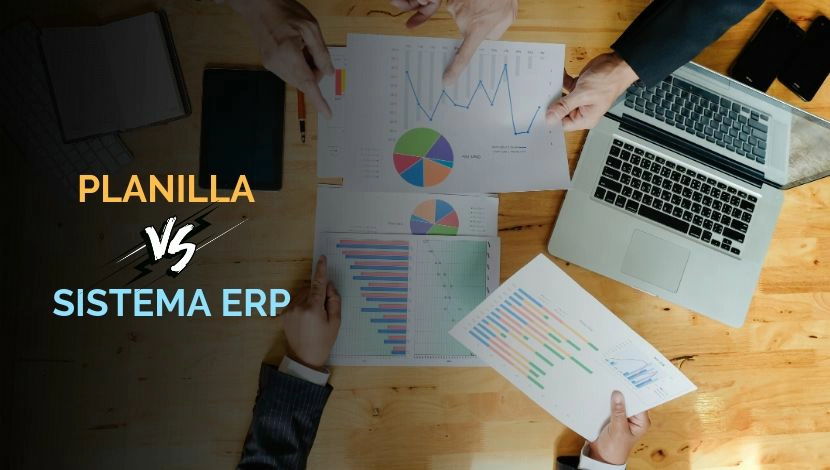
Infographic: Spreadsheets VS ERP Systems
Conclusion
Using spreadsheets or an ERP system is a decision that depends on many factors. For example, the size of the company: if you are starting your business, have little invoicing, and have few employees, you could choose spreadsheets.
However, if you have a company that handles a lot of information and is growing, an ERP system is the best solution for you. It will allow you to increase detailed visibility into your business and perform analyses to make the best decisions.
In any case, it is essential to carefully analyze whether your organization has outgrown spreadsheet capabilities and needs to migrate to an ERP system. Here are some signs that will help you make the decision:
- You have employee, customer, and supplier data saved on your computers or devices, but it is not connected and is stored in scattered locations… finding the data is a headache!
- Your employees spend more time collecting and organizing data than working with it.
- It is difficult to obtain information in real time.
- You cannot access your data from anywhere, on any device, at any time.
- You have limited access to information from mobile devices, for example, you can view information but cannot edit it.
Spreadsheets remain a tool for managing basic business processes and play a valuable role specifically in financial analysis, reports, and dashboards. However, they are not flexible, secure, or capable of integrating all areas of the company.
Ultimately, there are plenty of reasons to choose ERP software as a comprehensive technological solution that gives you maximum agility and efficiency in business management.
Do you want to see the challenges and solutions of ERP software in a real case?
Learn about the challenges Grupo Barr faced and the solutions and results obtained by implementing Inventiva’s software.