In 2022, artificial intelligence became the number one topic in forums, articles, and social media of all kinds.
No matter where we looked, AI was present.
In the algorithms of streaming platforms and social networks, in the Internet of Things, in our companies’ systems, and, of course, in the famous generative artificial intelligence platforms, such as ChatGPT or Google Bard (Gemini).
Its ability to analyze information, automate tasks, and optimize processes was changing everything, including the way businesses are managed.
And that is exactly what we will see next…
- The impact of artificial intelligence applied to ERP systems to revolutionize business management,
- how this technology helps companies improve their competitiveness, and
- the economic benefits that can be obtained by implementing an ERP with AI.
If you still have doubts about how AI can boost your operations, marketing, sales, and business management, keep reading…
Artificial Intelligence Applied to ERP Systems
Well, to understand the advantages that AI applied to ERP software can deliver, it is necessary to start with the fundamentals.
What is it, what does it consist of, and how does it work?
Artificial intelligence applied to ERP refers to the use of advanced AI technologies within an ERP platform to optimize and automate business tasks.
Indeed, traditional ERP systems already provide a platform for resource and operations management, but without AI, these tasks can still remain complex.
When AI capabilities are integrated, these systems can take efficiency and decision-making to a completely new level.
In simple terms, AI in an ERP acts as an advanced brain that processes large volumes of data, learns from it, and offers recommendations or automatic actions based on identified patterns.
→ This means that manual tasks, such as inventory management, sales forecasting, or even customer service, can be managed automatically and more accurately by a system that “learns” from historical data and business behaviors.
Another important aspect is immediate access to this information to make accurate decisions.
In this sense, AI is allowing companies to anticipate trends in order to respond and adapt to changing market needs.
Data Worth Remembering
- The origins of AI date back to the 1950s, when it began to be explored as a branch of computer science.
- For decades, its application was limited to academic research and experimental projects.
- Since the 1980s, AI began to be used in the business world to solve complex problems in specific industries, such as manufacturing and finance.
- Since 2000, it began to become part of information systems for companies.
- By 2022, generative artificial intelligence produced around 40 billion dollars in revenue.
Back to the present…
AI found its place in more complex and advanced systems, such as ERPs, thanks to the rise of neural networks, machine learning, and cloud computing.
In other words, the development and growth of other technologies made it possible for artificial intelligence applied to ERPs to be a key component of business today.
What Artificial Intelligence Achieves in an ERP System
As mentioned earlier, when artificial intelligence is integrated into an ERP, improvements in different key areas are notable, for example:
Automation of Repetitive Tasks
AI is excellent at handling routine and repetitive tasks, such as accounting, payroll management, and invoice processing.
By optimizing these processes, the administrative team in this example can focus on more strategic activities.
The same happens with inventory management, where, for example, product replenishment can be automated by generating purchase orders based on sales history and stock levels.
In both cases, task automation saves time, provides greater control, and improves operational efficiency.
Predictive Analysis
AI’s ability to analyze large volumes of historical data allows companies to forecast future trends.
For example, you can predict when products in stock will run out, when machinery maintenance will be necessary, or anticipate seasonal demand for certain products.
This last point is very important because it helps companies better plan their resources and avoid overloads or stock shortages during critical periods.
Data-Based Decision-Making
Major decisions within an organization cannot be based on intuition; they must be based on clear and accurate information.
And in this field, AI works exceptionally well.
Good ERP software with business intelligence allows you to access the data, charts, and analyses you need immediately so you can make better decisions.
Improved Customer Service
One of the most demanding areas, where providing a satisfying experience can be a real challenge, is customer service.
ERP systems with AI can analyze customer interactions, identify behavior patterns, and provide personalized recommendations to improve the customer experience.
In addition, they can automate responses to frequent inquiries and reduce response times, enabling faster and more effective service, even during demand peaks.
Supply Chain Optimization
AI can identify bottlenecks in the supply chain and propose improvements, helping reduce delays and optimize logistics processes.
Delivery routes can even be optimized to reduce distribution costs and times based on the information provided by artificial intelligence.
Artificial Intelligence Technologies Applied in an ERP
Well, to understand the true impact of artificial intelligence applied to ERP, it is essential to know the key technologies that make its integration possible.
It is worth mentioning that all of them, in addition to improving system efficiency, improve competitive advantage by transforming the way companies manage their operations.
Among these technologies, the following stand out:
1. Machine Learning
Machine Learning allows ERP systems to continuously “learn” from the historical data they process.
This means that, as more data is collected and analyzed, the system becomes smarter and capable of identifying patterns that could go unnoticed at first glance.
For example, the ERP can suggest inventory purchases based on demand trends or even adjust stock levels to avoid both shortages and excess.
In addition, machine learning makes it possible to optimize internal processes, such as resource planning, adapting recommendations based on past behavior and forecasting future needs.
2. Chatbots and Virtual Assistants
Chatbots and virtual assistants are one of the most visible and accessible applications of AI in ERP systems.
→ Designed to provide an immediate response to customer or employee inquiries, these systems enable fast and efficient service, reducing waiting times and optimizing the user experience.
And, if the chatbot is well designed, it can also manage internal tasks, such as data queries or routine processes.
According to Botpress, chatbots can answer up to 79% of routine inquiries.
Another point in favor of this technology is that it can be trained to adapt and improve its accuracy, continuously learning from previous interactions.
3. Predictive Analysis
One of the most powerful characteristics of AI in an ERP is its ability to predict future events based on historical data.
And this is especially useful for anticipating:
- cash flow fluctuations,
- equipment maintenance needs,
- changes in supplier prices,
- variations in market behavior, and
- product demand.
With predictive analysis, companies can prepare for different scenarios further in advance, improving strategic planning and minimizing risks.
4. Recommendation Systems
Recommendation systems are another crucial piece of artificial intelligence in ERPs.
→ These systems analyze large volumes of data to suggest specific actions that optimize processes within the company.
For example, they can recommend the implementation of new operational processes, identify areas where costs can be reduced, or propose which products have the greatest potential for success in the market.
In addition, recommendation systems can personalize suggestions based on the behavior and specific needs of each company, helping organizations act more agilely and effectively in their decisions.
5. Anomaly Detection
An ERP with AI can identify unusual or out-of-the-ordinary behaviors in real time, whether in financial processes, the supply chain, or production operations.
For example, if there is an unexpected increase in production costs or a decrease in a machine’s performance, the system can alert those responsible before the problem seriously affects the company.
This not only improves operational efficiency but also significantly reduces financial and operational risks.
Benefits of Using an ERP with Artificial Intelligence
After analyzing some of the most well-known technologies, we can talk about how your business can benefit from artificial intelligence applied to ERP.
And although we have mentioned many advantages throughout the article, we believe it is important to highlight the following:
- Greater accuracy in decision-making
Thanks to AI-based analysis, directors and members of the organization can make more informed and accurate decisions, reducing the margin of error and improving long-term results.
- Cost reduction
By automating routine tasks and optimizing processes, your company can significantly reduce operating and labor costs.
- Improved productivity
Task automation and fast response to problems allow your employees to focus on more strategic activities, increasing the company’s overall productivity.
- Personalization of the customer experience
ERP systems with AI can analyze customer behavior patterns and offer personalized products or services, improving customer satisfaction and loyalty.
- Scalability
As your company grows, the ERP with AI can adapt without requiring major infrastructure investments, since AI learns and improves over time.
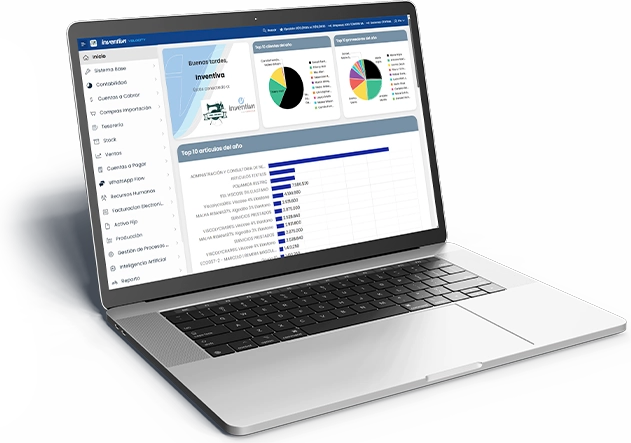
Inventiva ERP with Artificial Intelligence
Artificial intelligence applied to ERPs represents a paradigm shift in the way companies manage their daily operations.
And at Inventiva, we understand this perfectly.
That is why we offer the Paraguayan market a complete and flexible ERP software that implements technologies such as machine learning, predictive analysis, process automation, and business intelligence.
We are talking about an ERP with more than 100 modules available for immediate implementation, modern and effective.
It is software that, of course, includes all the benefits of artificial intelligence mentioned above.
Do you want to know more about Inventiva’s ERP systems?
Click the button below to speak with a consultant.